HMI Design Guidelines for every project

After building two user interfaces this year and having to formulate and review the rules for developing an effective set of screens each time, this is a list of seven items created from experience, client feedback and research.

7 HMI Design Guidelines

1. Do not use black or white for background. It appears that this would bring about good contrast and highlight objects onscreen but to the contrary, it succumbs to glare in many lighting conditions including sunlight and fluorescent lighting.

2. Low contrast general themes are better in industrial user interfaces for the following reasons: 1- It helps highlight situations that require awareness, 2- It’s not too eye catching as an industrial control system should be. Captivating graphics may steal from the actual intent.

3. Use graphs and trend information where possible. Visual aspects of monitored variables allowsfor easier troubleshooting. Historic view of what the variable has done whether a few minutes ago or a few hours ago helps operators with decision making. A trend can also captures a relative view of the current state with respect to limits and also in relation to other variables.

4. Articulate situations that are beyond acceptable or normal operating regions using bar graphs and colors( red, yellow green). This supports the notion of providing a relative view of the status of a process variable or condition.

5. Do not use too many elements that do not carry data significance. Example: An elaborate drawing of a plant or process with only 4 or 5 actual data fields may serve as a distraction. The idea is not to amaze users/operators/viewers with the graphics but to provide information and allow for efficient and optimal control.

6. Consider replacing color based information with shapes- helps with color blindness and confusion on the meaning of colors. Example: Does RED infer push to stop or currently stopped. Does green mean go or push to go?

7. Spacing between user input fields- avoid the proverbial ‘fat finger’. Example :Placing two input fields  together can cause  errors in data entry. Consider placing a label between input fields.

Share

Auto tuning VFD’s


What is auto-tuning to a VFD?

Auto tuning a VFD is a process by which a drive measures the impedance of a motor for the purpose adjusting the motor control algorithm. The measured value may be matched to known impedance for a given motor size and used in determining voltage and current relationships at different speeds. Ultimately, this allows for more effective  driving of a motor load as well as better speed regulation specifically when running without feedback ( open loop).

When not to auto-tune?

    1. Auto-tunes are generally to be performed when the motor is cold. Auto-tuning with a hot motor may result in a variance in impedance which will subsequently cause the execution of a motor control algorithm which does not accurately match the true motor impedance.
    2. When multiple motors are connected, an auto-tune will result in the reading of multiple motor impedances connected in parallel. Some auto-tune functions match impedance readings to known typical motor impedance values ( for instance a typical NEMA B motor). As such, the reading of multiple motor impedances in parallel can not be matched to a known motor impedance value or may match a different type of motor. This results in an unsuccessful auto-tune which may be signified by a higher than usual noise levels.
Share

Reactors and Filters in VFD Applications

Discussion on filters when associated with drives can include  line reactors, matrix filters and sinus filters among others. The filters can be on the line side of the drive for harmonic mitigation or transient protection purposes. On the load side, reactors may be used for reflected wave mitigation( caused by long motor lead lengths for example) or sinus filtering which is to filter out higher frequency components of the output of the drive to the motor.

A reactor is essentially an inductor which acts to ‘smoothen’ out the voltage on the line/load . These are typically applied in variants of 3% or 5% of the line impedance, thus reducing the voltage by 3% or 5%. Going from a reactors, other forms  of harmonic mitigation may involve  combination of reactors and capacitors.

The following manufacturers of power quality and filtering equipment have useful resources on the various techniques of filtering and their application in improving power quality with drives:

MTE : http://www.mtecorp.com/

TCI: http://www.transcoil.com/Support/Documentlibrary.htm


UPDATE: Another one that I had heard of but never used.

MIRUS : http://www.mirusinternational.com

Some good technical papers in the Downloads section including an interesting paper comparing Active Front End’s(AFE’s) to a regular 6 pulse rectifier front end and a filter.

Share

Characteristics of VFD regeneration situations


The motor operation characteristics during VFD regeneration, also referred to as regen are:

1. The motor flux fields as controlled by the drive are spinning in the same direction as the load that is driving it. If the shaft is being driven by the load but the inverter is not gating, no regen is captured as the stator circuit would be open.

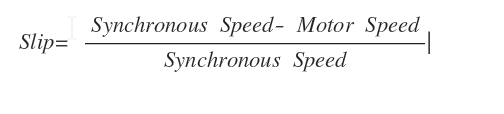
2. Slip is negative. Note, slip is defined as:

2015-01-15 22_08_43-Slip

Synchronous speed => speed of rotation of the stator induced flux field as drive by the VFD

Motor speed => Speed at which the load is driving the rotor

Share

Constant Torque Variable Frequency Drive Applications

Following up on a previous post about the few important formulae  when applying variable frequency drives specifically to ac induction motors, this post will get into  the topic of constant torque variable frequency drive applications.


Voltage,Current, Torque and Speed on a Constant Torque VFD Application

What is a constant torque application?                                                                                                        Constant torque applications may have close to a uniform torque requirement across the motor speed range.  The bigger consideration from the perspective of drive selection is that these applications will require relatively high torque at low speeds compared to a pump or  fan.

The actual requirement arises from the load attached to the motor. For example a connveyor may need to exert significant torque at low speeds if there are objects already on it. Another example is a progressive cavity pump which relies on positive displacement to move fluid.

Why is it important to distinguish the requirements of constant torque applications     ( versus variable torque)?      

1. Higher torque at lower speed requires better speed regulation capabilities within the drive. Without speed feedback from the motor, drives rely on electrical feedback in the form of current and voltage as well as phase angle vector analysis between the two to regulate the speed loop. For example, if speed drops, the drive will have to increase voltage through its IGBT gating control on the output to effect a speed increase. This determination is made continously and rapidly and in both directions (  to increase or decrease output voltage) to maintain a speed setpoint.

2. Higher torque at lower speed requires for the drive to handle higher current draw at low speed.

If torque is the same throughout – what happens to voltage and current throughout the speed range?

This is where reverting to the motor torque formula is useful.

Torque formula

Observations based on this formula are:

1. If torque stays the same ( constant torque) and the VFD output frequency (and motor speed)  is increasing between 0-60Hz, horsepower or motor power consumption has to increase.

2. Motor power is going to be made up of two components of interest to us here ( assuming power factor and efficiency are constant) and they are voltage and current. Torque is proportional to current which infers that current will not change ( much). That leaves a variance in voltage, which also happens to be the component that the drive can alter with its voltage source inverter nature.

Some variance does occur in motor current. One possible reason is that motor impedance characteristics are affected by frequency- this is a topic of its own.

The graph at the top of this post shows the motor torque, motor voltage and motor current across the speed range. The load torque required in this example case is about 50%.


Share

Variable speed drive speed, torque and power

The following are formulae used to calculate some important aspects of a variable speed drive application such as torque and speed.

Synchronous speed of an ac induction motor = 120 x frequency / number of poles,remembered easier with the formula :

synchronous speed formula

Where : f= frequency

p= number of poles

n = speed in rpm

Torque is defined as a rotating force or work in a rotary motion. When calculating work, we use the formula force x distance. As such, the formula for torque is force x radius. When converted into electrical terms:

Torque formula

3-phase Power calculation

Power (HP) = Voltage x Current x Power Factor x 1.73/ 746

DC bus voltage

To calculate the dc bus voltage of an ac drive, for a 3 phase rectifier on the drive input, the DC bus voltage is input ac voltage x √2

Another popular calculation related to motor loads in general is power factor.

Power factor is defined as the ratio of Real/Active Power (kW) over Apparent Power (kVA). The description and calculations related to power factor probably deserves a post of its own, to be included later.

Share

What is a Variable Frequency Drive or a Variable Speed Drive?

VSD’s or VFD’s , also referred to as frequency converters or adjustable speed drives, are devices that convert fixed frequency supply voltage ( typically 50Hz or 60Hz) to a variable frequency voltage. The frequency of voltage supplied to a motor determines the speed at which that motor rotates.

VSI_Topology

By Cblambert (Own work) [CC BY-SA 3.0 (http://creativecommons.org/licenses/by-sa/3.0)], via Wikimedia Commons

What are the benefits of a drive (VFD) over a motor starter?

    • Drives protect motors from the in rush of current when starting.
    • In applications where full speed operation is not required, drive saves energy by facilitating operation at lower speeds.
    • Drives allow for speed regulation to maintain the set point of a process ( could be a pump motor speed for pressure and flow or fan speed for temperature)
    • In applications where a high torque is required at a low speed, drives are able regulate both speed and torque at its output to allow for continuous operation a low speed. An example could be a hoist where the load is suspended ( at zero speed)in the air without the engagement of brakes.
    • Drives are able to provide current and torque limiting functionality so as to prevent motor and other equipment damage.

Share